What Is an Eyebrow Pencil Tube and Why Does It Matter for Your Product
An eyebrow pencil tube is the outer packaging component that houses, protects, and dispenses the eyebrow pencil formula — whether that formula is a wax-based pencil core, a mechanical retractable crayon, a micro-tip fiber pencil, or a twist-up brow product. While end consumers primarily evaluate an eyebrow product by its formula, finish, and color range, the tube is the component that determines how easy the product is to use, how precisely it can be applied, how durable it is in a makeup bag, and how the brand communicates quality and identity at the point of sale. A poorly engineered eyebrow pencil tube that breaks, jams, or dispenses inconsistently will damage consumer perception of even an excellent formula, making tube selection one of the most consequential packaging decisions in eyebrow product development.
For cosmetic brands, contract manufacturers, and private label buyers, understanding the full landscape of eyebrow pencil tube components — mechanisms, materials, tip types, cap configurations, and decorating options — is essential for specifying the right packaging for a product's intended market positioning, price tier, and performance requirements. The eyebrow pencil packaging market has evolved considerably over the past decade as brow products have become one of the highest-growth categories in color cosmetics, and the variety of tube formats and mechanisms now available is significantly broader than it was even five years ago.
Main Types of Eyebrow Pencil Tube Formats
Eyebrow pencil tubes are not a single product category — they encompass several distinct mechanical formats, each suited to a specific formula type and application experience. Choosing the right format is the first decision in the specification process, as it determines which component suppliers can be approached and what formula viscosity and structure is compatible with the tube mechanism.
Twist-Up Eyebrow Pencil Tubes
The twist-up eyebrow pencil tube is the most widely used format across all market segments. It uses a threaded internal mechanism — driven by rotating the base or the cap — that advances a plastic or metal elevator platform carrying the pencil core upward through the barrel as the user twists. The mechanism's pitch determines how much core is advanced per rotation, which affects both the precision of dispensing and how quickly the product is consumed. Well-engineered twist-up mechanisms for eyebrow pencils advance approximately 0.3mm to 0.5mm per full rotation, giving the user fine control over how much product is exposed. The format accommodates wax-based pencil cores, retractable crayon formulas, and soft brow pomade sticks, making it the most versatile tube format in the eyebrow category.
Mechanical Pencil-Style Eyebrow Tubes
Mechanical eyebrow pencil tubes function like traditional wooden pencil sharpeners replaced by a click-advance mechanism — each click of the cap end advances a thin pencil core by a fixed increment, typically 0.5mm to 1.0mm. This format is closely associated with ultra-fine micro brow pencils that use a triangular or hair-stroke tip designed to draw individual hair-like strokes for natural-looking brow definition. The mechanical advance mechanism requires a rigid, precisely extruded pencil core that can be gripped and advanced by the chuck mechanism without crumbling or slipping. This format is more mechanically complex and typically more expensive than a twist-up tube, but the ultra-fine application it enables has made it the dominant format in the premium precision brow pencil segment.
Retractable Cap Eyebrow Pencil Tubes
Retractable cap eyebrow pencil tubes expose a fixed, pre-set tip length when the cap is removed, with no advance mechanism — the pencil core is set at a permanent protrusion length from the barrel. This is the simplest and lowest-cost tube format and is most commonly used for firm, defined brow pencil cores that do not require controlled advancement. Because there is no mechanism to advance the core, the user sharpens the product with an external sharpener as the tip wears — a familiar experience for traditional wooden eyebrow pencils translated into a plastic or aluminum barrel. This format is cost-effective for mass-market positioning but offers less precision control than twist-up or mechanical advance alternatives.
Dual-Ended Eyebrow Pencil Tubes
Dual-ended eyebrow pencil tubes combine two functional components in a single package — typically a pencil tip at one end and a spoolie brush, brow gel applicator, or highlighting formula at the other. The two ends are joined at the center and capped at both extremities, creating a symmetrical tube that is longer than a single-ended component but delivers two complementary functions in one SKU. Dual-ended eyebrow packaging is popular across mid-market and premium positioning because it offers perceived value and functional completeness in a single purchase. The mechanical complexity of reliably joining two separate functional components with compatible twist or advance mechanisms requires more rigorous engineering specification than single-ended tubes.
Materials Used in Eyebrow Pencil Tube Construction
The material composition of an eyebrow pencil tube affects its visual quality, tactile feel, weight, durability, environmental footprint, and unit cost. Most eyebrow pencil packaging is produced from plastics, with aluminum and hybrid constructions used in premium and sustainable positioning tiers. Understanding the material options and their trade-offs helps brands make specification decisions that align with their product positioning and sustainability commitments.
| Material |
Common Use |
Advantages |
Limitations |
| ABS Plastic |
Barrel, cap, mechanism body |
Rigid, cost-effective, excellent print adhesion, wide color availability |
Not biodegradable; lower perceived premium feel than metal |
| PP (Polypropylene) |
Internal mechanism components, elevator, chuck |
High chemical resistance, flexible enough for snap-fit components, lower cost than ABS |
Lower rigidity; surface finish less premium than ABS for visible parts |
| Aluminum |
Premium barrel and cap outer shell |
Premium weight and feel, excellent anodizing and engraving options, recyclable |
Higher tooling and unit cost; heavier; mechanism integration more complex |
| PCR Plastic |
Sustainable barrel and cap |
Reduced virgin plastic content; supports sustainability claims; familiar processing |
Color variation batch to batch; higher cost than virgin plastic; limited to gray-toned or opaque finishes |
| Bio-based Plastics |
Sustainable positioning tubes |
Reduced fossil fuel dependence; marketing differentiation |
Higher cost; limited supplier base; certification verification required |
Tip Configurations and Their Impact on Application Performance
The tip configuration of an eyebrow pencil tube — the geometry of the formula core at the application point — is one of the most significant differentiators between eyebrow pencil products and has a direct effect on the application experience the consumer receives. Different tip formats suit different brow styles, skill levels, and formula viscosities. Packaging buyers specifying an eyebrow pencil tube must ensure the tip geometry is compatible with both the formula hardness and the intended use case.
Micro-Fine Tip (0.07mm – 0.1mm)
The micro-fine tip is the defining feature of the precision brow pencil segment and is closely associated with the mechanical advance tube format. Tips in the 0.07mm to 0.1mm diameter range produce individual hair-like strokes that mimic real brow hairs and are used for hyperrealistic brow makeup that requires no blending or diffusion. This tip geometry demands a very firm, dry formula core that can be extruded to ultra-thin cross-sections without crumbling — softer or waxier formulas cannot maintain structural integrity at this tip diameter and will break during application. The mechanical pencil tube mechanism that advances this tip must hold the core with very precise chuck tension to prevent both slipping back into the barrel and snapping during use.
Fine Triangular Tip (1mm – 1.5mm)
Fine triangular or teardrop-shaped tips provide a middle ground between micro-precision and broader fill capability. By rotating the pencil during use, different edges of the triangular cross-section produce different line widths — the point for fine hair strokes and the flat face for broader filling passes. This format is extremely popular in mid-market and premium eyebrow pencil tubes because it provides versatility within a single tip, accommodating both detail work and overall brow shaping without requiring the consumer to switch tools. Triangular tips work well with firm to medium-firm formula cores and are compatible with both twist-up and mechanical advance tube mechanisms.
Flat Chisel Tip (2mm – 3mm)
Flat chisel or paddle-shaped tips are designed for brow pomade sticks and softer formula eyebrow pencils where the application goal is filling and shaping the brow body rather than drawing individual hair strokes. The wider flat face deposits color efficiently across a larger area, and the edge of the chisel can be used for more defined lines along the brow boundary. This tip format is most commonly found in twist-up brow pencil tubes with pomade-type formulas that have a creamier, higher-pigment payload than wax-based pencil cores. The softer formula compatible with this tip requires a mechanism that advances the core gently without applying excessive compression that could deform the product.
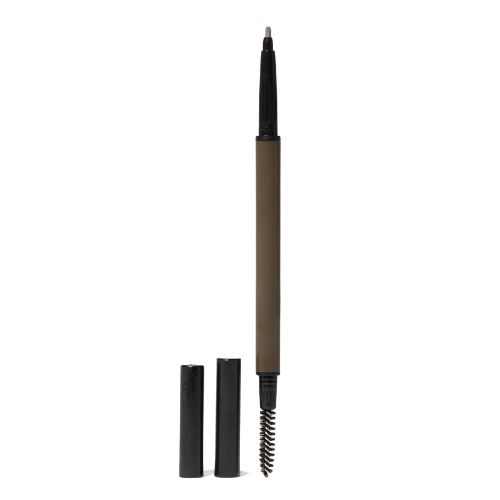
Cap Design and Spoolie Integration in Eyebrow Pencil Tubes
The cap of an eyebrow pencil tube does more than protect the formula from drying out — it is often a functional component in its own right and a significant contributor to the overall product experience. Cap design considerations include closure security, ease of removal with one hand, material and finish consistency with the barrel, and whether the cap incorporates an additional functional element such as a spoolie brush.
Spoolie integration — where a mascara-wand-style fiber brush is mounted inside the cap so that removing the cap immediately presents the spoolie for blending — is one of the most practically important features in eyebrow pencil tube design. A spoolie at the cap end allows the user to draw brow strokes with the pencil tip, then flip the product and blend with the spoolie brush without putting down and picking up a separate tool. The spoolie fiber specification matters significantly for performance: fiber length, fiber density, core diameter, and the rigidity of the fibers collectively determine whether the spoolie blends product effectively, shapes and sets the brow hairs, or simply drags across the surface without engaging the product. High-quality spoolie integration in premium eyebrow pencil tubes uses fiber counts and lengths tuned specifically for brow hair texture rather than repurposing mascara wand components designed for a different application.
Key Quality Standards for Eyebrow Pencil Tube Mechanisms
The mechanical reliability of an eyebrow pencil tube is a critical quality parameter that directly affects consumer satisfaction and brand reputation. Unlike secondary packaging such as outer cartons or labels, a mechanism failure — a stripped thread, a jammed elevator, a snapping chuck — renders the product completely unusable and generates the type of negative consumer review that is disproportionately damaging to eyebrow products where application precision is the primary purchase driver. Specifying mechanism quality requires establishing clear acceptance criteria before production begins.
- Advance consistency: The core advancement per rotation or click must be consistent within ±0.05mm across the full travel range of the mechanism. Inconsistency — where early rotations advance more than later ones — indicates thread wear or dimensional variation in the internal components that will worsen over the product's use life.
- Retraction capability: For twist-up formats, the mechanism must retract the core cleanly and fully when rotated in reverse without the core separating from the elevator platform or becoming lodged in the barrel bore. Test retraction across the full advance range, not just from the initial position.
- Cap retention force: The cap must stay closed under normal bag-in-handbag conditions — typically tested by shaking a loaded bag containing the pencil — but must be removable with one hand without requiring excessive grip strength. A removal force of 2N to 5N is generally the target range for eyebrow pencil caps; below 2N risks accidental opening, above 5N creates usability complaints.
- Drop resistance: The assembled pencil tube must survive a standardized drop test — typically five drops from 1.0 to 1.2 meters onto a hard surface at various orientations — without mechanism failure, cap ejection, or barrel cracking. This is particularly important for mechanical advance tubes where the chuck mechanism is vulnerable to impact damage.
- Torque consistency for twist-up mechanisms: The rotational torque required to advance the mechanism should be consistent — neither so light that the product advances unintentionally nor so heavy that the consumer finds operation effortful. Measure opening torque on a sample of 30 or more units from each production batch to confirm consistency and identify tooling wear that is increasing resistance over the production run.
Decoration and Branding Options for Eyebrow Pencil Packaging Tubes
The decorative finish of an eyebrow pencil tube is the primary visual communication of brand identity and product positioning at the point of sale. Because eyebrow pencils are typically narrow, cylindrical components displayed in multi-unit rows on retail fixtures or shown individually in e-commerce product images, the decoration must be legible, durable, and visually distinctive at small scale. The main decoration methods available for eyebrow pencil tubes each have different cost implications, minimum order quantity requirements, and aesthetic outcomes.
- Hot stamping: A metallic or pigmented foil is transferred to the barrel surface under heat and pressure using a engraved die. Hot stamping produces crisp, high-contrast metallic or matte decoration with excellent durability and no ink build-up. It is the most common decoration method for logo and brand name placement on premium eyebrow pencil tubes and is well suited to simple text and graphic elements. Complex multi-color designs are less economical in hot stamping than in print-based methods.
- Screen printing: Ink is pushed through a mesh screen onto the barrel surface, depositing a flat ink layer that cures under UV light or heat. Screen printing accommodates multi-color designs, brand graphics, and product information in a single pass per color layer. It is the standard decoration method for mass-market eyebrow pencil tubes and offers good color accuracy at moderate cost. Ink adhesion on curved surfaces must be tested against the specific barrel material and surface treatment before production commitment.
- Labeling: A pre-printed pressure-sensitive or heat-shrink label is applied to the barrel. Labeling offers the fastest turnaround, lowest tooling cost, and maximum flexibility for short runs, color changes, and multi-market regulatory text requirements. Label durability on cosmetic tubes — particularly resistance to abrasion, moisture, and beauty product contact — must be specified carefully, as standard label stocks and adhesives designed for retail packaging may not withstand conditions inside a makeup bag.
- In-mold color and material color matching: For cleaner aesthetics without surface decoration, the barrel and cap can be molded in a custom matched color using masterbatch pigment. This produces a seamless color without any applied decoration layer that can scratch or peel, and is widely used for minimalist brand aesthetics. Custom color matching typically requires a minimum masterbatch production quantity and adds lead time for color approval before tool production begins.
- Anodizing and engraving for aluminum tubes: Aluminum barrel eyebrow pencil tubes are decorated by anodizing — an electrochemical process that produces a hard, colored oxide layer directly on the metal surface — and laser engraving, which removes the anodized layer to reveal a contrasting bare aluminum line. The combination of colored anodizing and laser-engraved logo creates a premium, tactile decoration effect unique to metal tubes and is one of the clearest visual differentiators between luxury and mass-market eyebrow pencil packaging.
Sustainable Eyebrow Pencil Tube Options: What's Actually Available
Sustainability in cosmetic packaging has moved from a niche differentiator to a mainstream expectation in most retail markets, and eyebrow pencil tubes are no exception. Brands specifying new eyebrow pencil packaging are increasingly required — either by retailer sustainability requirements, regulatory frameworks, or consumer demand — to demonstrate a credible reduction in environmental impact relative to conventional plastic packaging. Understanding what is genuinely available at commercial scale versus what remains aspirational or at pilot stage is important for making realistic specification decisions.
Post-consumer recycled (PCR) plastic content is the most commercially mature sustainable option for eyebrow pencil tube barrels and caps. PCR resin made from recycled bottles and packaging is available from established suppliers in grades suitable for injection molding, and PCR content of 50–100% is achievable for opaque tube components without significant performance compromise. The limitations are color consistency — PCR resins have a natural gray or off-white base that limits achievable color range — and cost, which is typically 15–30% higher than virgin plastic equivalent grades. Refillable eyebrow pencil tube systems — where the outer barrel and mechanism are designed to accept a replaceable formula cartridge — represent a more significant sustainability advance but require a greater investment in mechanism engineering, consumer communication, and retail reverse logistics infrastructure that most brands are still building toward rather than operating at scale.
What to Evaluate When Sourcing Eyebrow Pencil Tubes from Suppliers
Whether sourcing through a cosmetic packaging distributor, a direct component manufacturer, or a turnkey contract manufacturer who supplies filled and assembled pencils, the evaluation criteria for eyebrow pencil tube suppliers should cover technical capability, quality management, regulatory compliance, and commercial terms. The following checklist covers the essential areas to address before committing to a supplier or placing a production order:
- Request a fully assembled prototype with your formula before tooling investment: Mechanism-formula compatibility — particularly chuck grip on your specific core diameter and hardness, and elevator platform compatibility with your formula weight and dimensions — must be confirmed with physical prototypes running your actual formula before committing to production tooling, which typically costs $3,000 to $15,000 per component and cannot be recouped if the mechanism proves incompatible.
- Confirm regulatory compliance documentation: For cosmetic packaging in EU, US, UK, and major Asian markets, component materials must comply with relevant regulations — EU Cosmetics Regulation 1223/2009 for material safety, California Proposition 65 for restricted substances, and increasingly Extended Producer Responsibility (EPR) packaging reporting requirements. Request Reach SVHC declarations, material safety data, and any market-specific compliance certificates relevant to your distribution territories.
- Evaluate minimum order quantities against your production volumes: Eyebrow pencil tube components from established suppliers typically have MOQs of 10,000 to 50,000 units per component per color. For brands launching new SKUs, high MOQs create inventory risk if the product does not achieve forecast sales. Confirm whether the supplier offers lower MOQ options for initial launch quantities and what the price differential is versus full production volumes.
- Assess production lead times and tooling ownership terms: Standard production lead times for eyebrow pencil tube components range from 6 to 14 weeks from purchase order, with new tooling adding 4 to 8 weeks before samples can be reviewed. Confirm whether tooling ownership transfers to your brand on payment or remains with the supplier, as tooling ownership affects your ability to switch manufacturers in future production cycles.
- Review the quality control process and AQL inspection standards: Confirm that the supplier performs incoming material inspection, in-process quality checks, and final AQL inspection before shipment. Request the AQL level applied to critical defects — mechanism failure, cap non-retention, visible surface defects — and cosmetic defects. Most professional cosmetic packaging suppliers apply AQL 1.0 to critical defects and AQL 2.5 to major cosmetic defects as minimum standards.



 中文简体
中文简体